RailComplete 2.0.0 ist erschienen

Wir veröffentlichen RailComplete 2.0.0. Die wichtigsten Neuerungen dieser Version sind die automatische Installation von Patches, ein neuer 3D-Betrachter für ausgewählte Objekte, der Querschnittsbetrachter mit einer Assistenzfunktion für Installationszeichnungen, die Typzuordnung und die Bearbeitung der räumlichen Struktur im IFC-Export sowie der IFC-Import von Achsen. Dazu kommen mehrere Verbesserungen bei Geschwindigkeit und Benutzeroberfläche, Fehlerbehebungen und kleinere Funktionen.

Neben den funktionalen Änderungen ändern wir auch den Namen und das Versionsformat der Software. Die Software heißt jetzt RailComplete statt RailCOMPLETE, und das neue Versionsformat lautet [Hauptversion].[Nebenversion].[Patchnummer] statt [Jahr].[Version].[Patchnummer].

Weitere Informationen finden Sie in den Versionshinweisen. Behalten Sie außerdem diese Seite im Auge: In den kommenden Wochen veröffentlichen wir hier weitere Informationen zu den wichtigsten Neuerungen. Ein Artikel über den verbesserten IFC-Export ist bereits verfügbar.

Zum Herunterladen besuchen Sie https://railcomplete.com/download.
RailComplete 2.0.0 est disponible

La version 2.0.0 de RailComplete est disponible. Les principales nouveautés de cette version sont l’installation automatique des correctifs, une nouvelle visionneuse 3D pour les objets sélectionnés, une visionneuse de coupes transversales avec une aide à la création de dessins d’installation, la correspondance de type et la gestion de la structure spatiale pour l’export IFC, ainsi que l’import d’axes IFC. S’y ajoutent plusieurs améliorations de la vitesse et de l’interface utilisateur, des corrections de bogues et des fonctionnalités mineures.

En plus de ces évolutions fonctionnelles, nous changeons le nom et le format de version du logiciel. Le logiciel s’appelle désormais RailComplete au lieu de RailCOMPLETE, et le nouveau format de version est [version majeure].[version mineure].[numéro de correctif] au lieu de [année].[version].[numéro de correctif].

Pour plus d’informations, consultez les notes de version et suivez cette page : nous y publierons dans les semaines à venir davantage d’informations sur les principales nouveautés. Un article sur l’export IFC amélioré est déjà disponible.

Pour télécharger, rendez-vous sur https://railcomplete.com/download.
Improved IFC Export in RailCOMPLETE 2.0.0

The RailComplete (RC) IFC export has until now been mostly automatic with quite limited control over the exported file. With RC 2.0.0 we are introducing several tools to let users tailor the export to make sure the file is formatted as they want it. This article will provide a short introduction to the new Manage IFC Spatial Structure window, improved IFC entity type mapping, changes in property set data types along with IFC data type mapping and the new ability to add property sets (Psets) to IFC entity types.

Spatial Structure

Previous versions of RC exported a set spatial structure, with only Names and LongNames editable in RC 2026.1. In RC 2.0.0 you can design any spatial structure in the new Manage IFC Spatial Structure window (see Figure 1), accessible through the command RC-ManageIfcSpatialStructure or through the “Manage IFC Spatial Structure” button under “Edit” in the ribbon.

Figure 1: The Manage IFC Spatial Structure window. The root node is exported as the IfcProject.

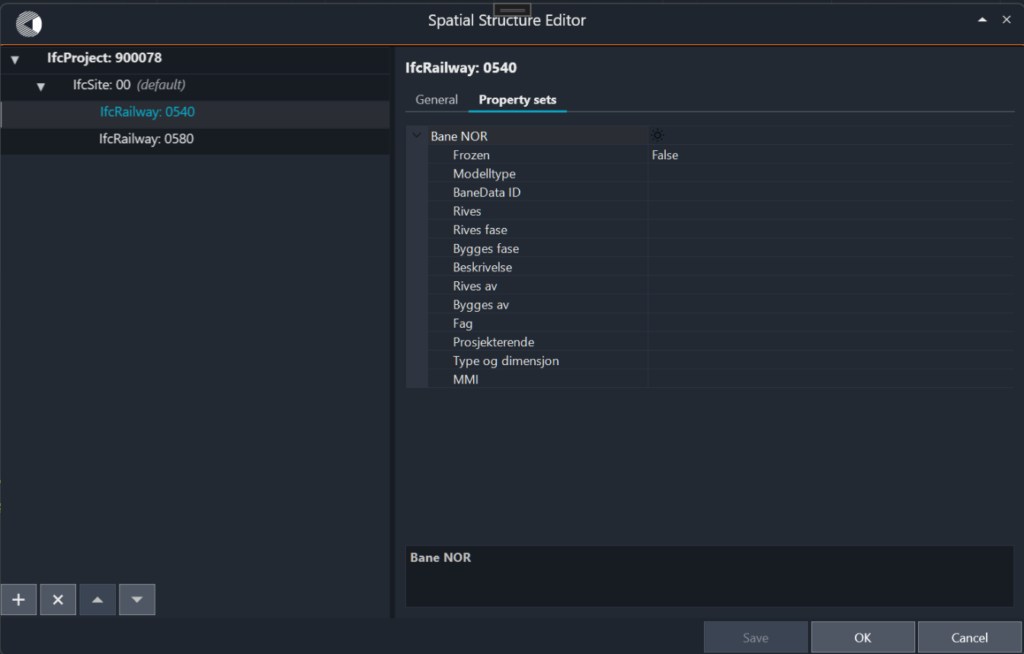
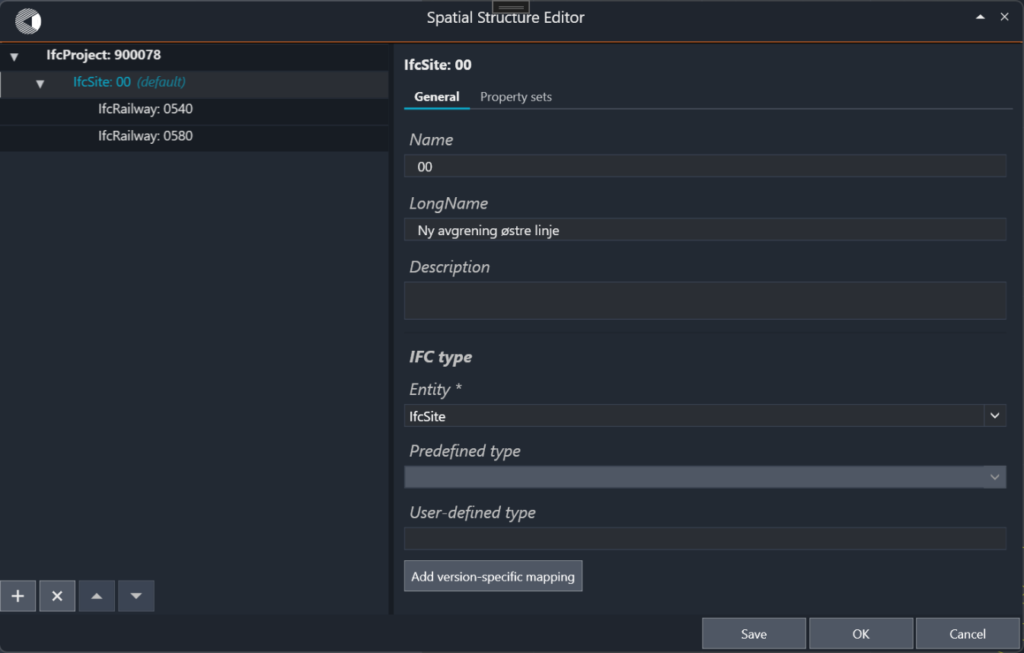
Here you can define a tree of spatial structure nodes on the left-hand side and set the properties for the selected node on the right. You can have as many levels as you like, but the tree must always have a single root node, which will be exported as the “IfcProject” of the export file. The available properties for a node are “Name”, “LongName”, “Description” and “IFC type”. IFC type sets the entity type of the resultant IFC element and has three parts: “Entity”, “Predefined type” and “Object type”. Each node can be any “IfcSpatialStructureElement”, with corresponding “Predefined type”. If “Predefined type” is set to “USERDEFINED”, or if the entity has no predefined types, then you can set “Object type”. Spatial structure nodes can also have property sets with additional properties (see Figure 2). See the “Standard IFC property sets” section for how to add Psets to spatial structure nodes.

RC objects are placed in the spatial structure by using the “Spatial Structure Parent” field in the IFC section of the “3D” category in the property manager (see Figure 7).

Property Data Types in RC and IFC

Figure 2: A spatial structure with a site, building and storey. The Property sets tab lists the Psets attached to the selected node.

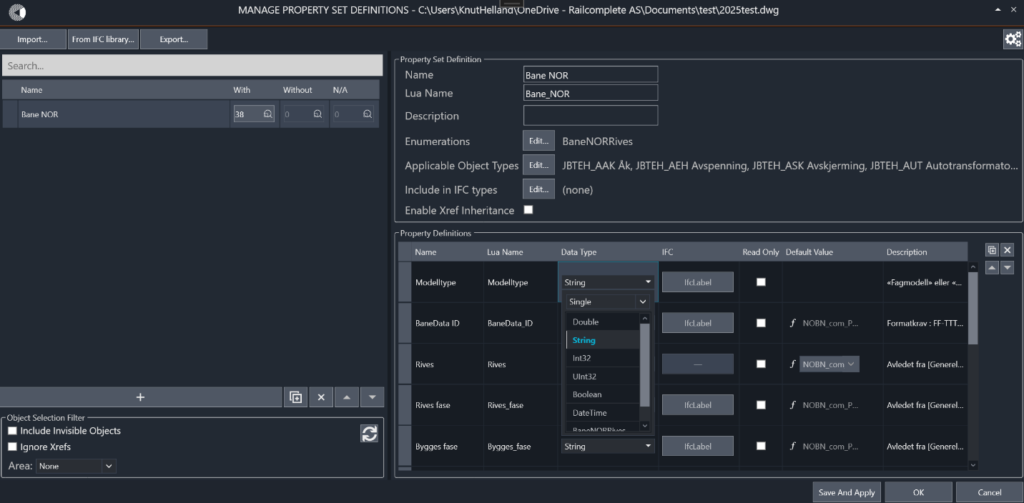
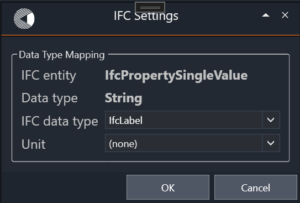
Property set properties in RC have data types like “String” for text and “Double” for numbers. However, when exported to IFC the properties get IFC types like “IfcLabel”, “IfcText”, “IfcReal” or “IfcPositiveLengthMeasure”. In addition, every property is exported as either an “IfcPropertySingleValue”, “IfcPropertyBoundedValue”, “IfcPropertyListValue” or “IfcPropertyTableValue”. For previous versions of RC, we automatically mapped the RC data types to IFC data types, which were always exported as single values. In RC 2.0.0 we are introducing new primitive RC data types “Boolean” and “DateTime” as well as adding the option to store each property as a Single, Bounded, List or Table value. This is controlled from the “Manage Property Set Definitions” window as before (see Figure 3). There is also a new column, “IFC”, where you can set an explicit IFC data type that the property is mapped to during export (see Figure 4). This is where you would set a string to be an “IfcText”, rather than the default “IfcLabel”.

Figure 3: The Manage Property Set Definitions window, with the new data types and the IFC column.
Figure 4: Mapping a Double property to an explicit IFC data type and unit.

Standard IFC Property Sets

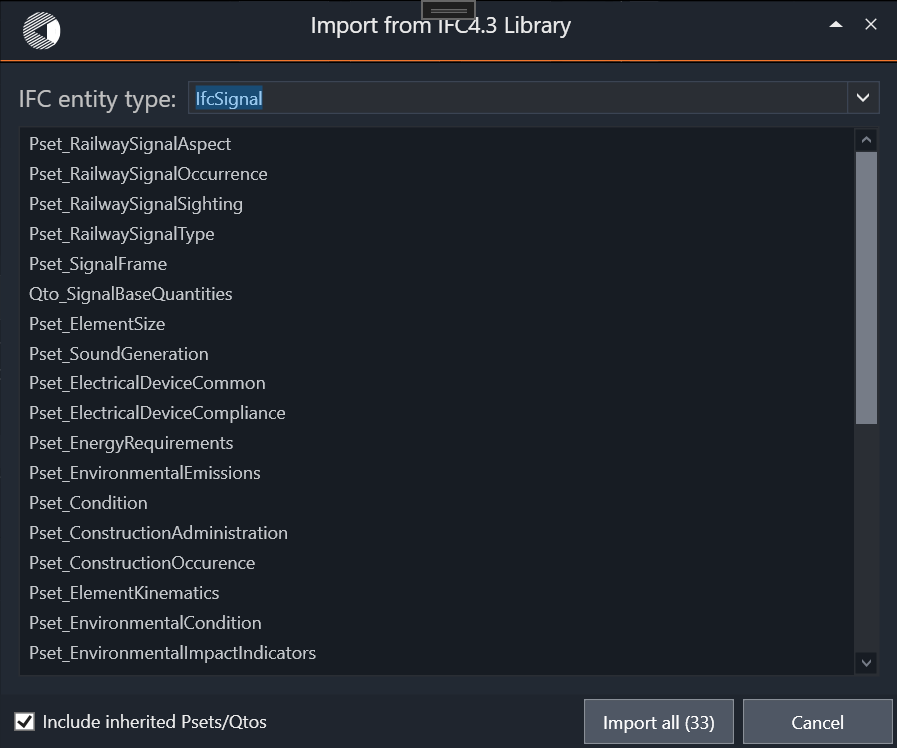
IFC 4.3 comes with standard property sets and quantity sets that should be attached to objects. These can now be easily added to RC with the “From IFC library…” button in the property set definitions manager which opens a window where you can import the relevant Psets and quantity sets for each IFC entity type (see Figure 5).

Figure 5: Importing standard Psets and Qtos for an IFC entity type with “From IFC library…”.

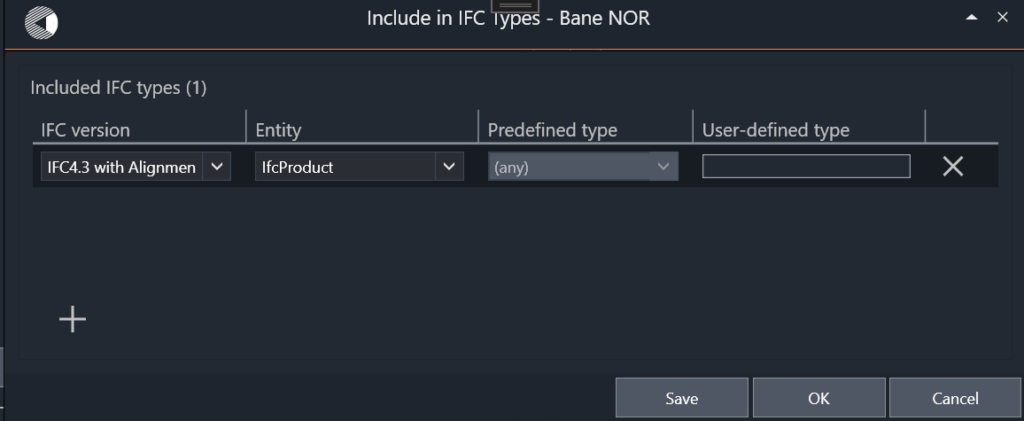
Which standard Psets and quantity sets that apply depends on an object’s IFC entity, not its RC type, so a Pset can now be attached by IFC entity. This is done with the “Include in IFC types” dialog available from the property set definitions manager (see Figure 6).

Figure 6: The “Include in IFC types” dialog, attaching a Pset by entity, predefined type and object type.

Here you select IFC entity types to which the Pset in question will be added. You can also select the inheritance ancestor entity type of the types in the drawing, for example “IfcSpatialStructureElement” to reach every spatial structure node below the root. This will also let you add Psets to spatial structure nodes that have no RC object type.

Setting IFC Types

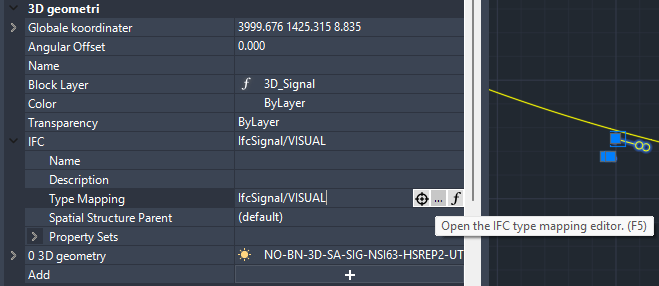
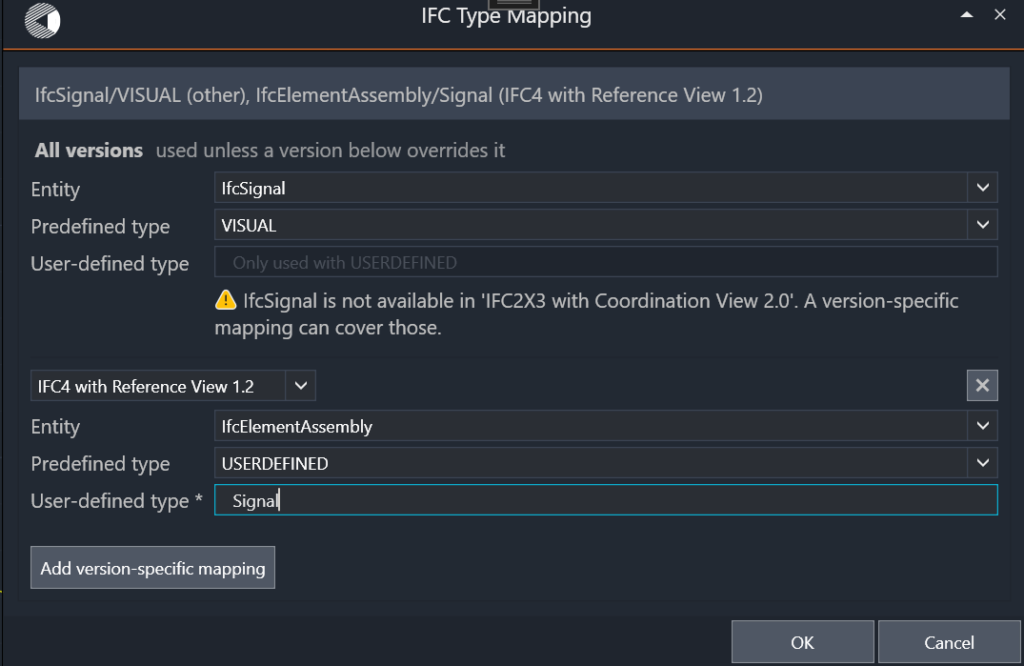
RC 2.0.0 replaces the “Entity Name” and “Predefined Type” text fields with a new field, “Type Mapping”. Like the old fields, it sits in the property manager in the IFC section under the “3D” category (see Figure 7). A type mapping is set through its own editor which provides dropdowns for “Entity” and “Predefined type” (see Figure 8). You can set “Object type” when “Predefined type” is “USERDEFINED” or the entity has no predefined types. You can also set different type mappings for different versions of IFC, if for example the entity used for 4.3 was not available in earlier IFC versions.

Figure 7: The new “Type Mapping” field in the IFC section of the property manager.
Figure 8: The type mapping editor, with a version-specific mapping for IFC2X3.

Export Settings

We have introduced three new settings to the 3D export to manage the structure of the exported IFC files:

  • “Ignore properties with empty value” leaves out anything not filled in.
  • “Use object’s RC type as its PredefinedType” is a back-up that is on by default but may now be switched off.
  • “Skip sub-parts that have no IFC entity name” may be used to simplify complicated sub-object structures when “Block Structure” on the “CAD” tab is set to “Preserve” rather than “Collapse”.

Lua

We provide new Lua API functions for helping with IFC and spatial structure:

  • getSpatialStructure() and setSpatialStructure() read and write the whole structure; nodes are matched by id, or by name under the same parent, so a matched node keeps its property sets and assigned objects.
  • getSpatialStructureParent() returns the id of the node an object exports into; getSpatialStructureNodePath() turns that id into a readable path. setSpatialStructureParent() assigns an object by node name, /-separated path or id. The set… functions are available in scripts only.
  • createIfcTypeMappings{ entity = “IfcSignal”, predefinedType = “VISUAL” } computes a type mapping from a formula, validated against the IFC entity tables.

RailComplete 2.0.0 er klar

Vi lanserer RailComplete 2.0.0. De viktigste forbedringene i denne versjonen er automatisk installasjon av patcher, en ny 3D-visning av valgte objekter, en tverrsnittsviser med hjelpefunksjon for installasjonstegninger, typetilordning og håndtering av romlig struktur i IFC-eksporten, samt import av IFC-alignments. I tillegg kommer flere forbedringer av hastighet og brukergrensesnitt, feilrettinger og mindre funksjoner.

I tillegg til de funksjonelle endringene endrer vi navnet og versjonsformatet til programvaren. Programvaren heter nå RailComplete i stedet for RailCOMPLETE, og det nye versjonsformatet er [hovedversjon].[delversjon].[patchnummer] i stedet for [år].[versjon].[patchnummer].

For mer informasjon, se versjonsnotatene, og følg med på denne siden. Her publiserer vi mer informasjon om de viktigste forbedringene i ukene som kommer. En artikkel om den forbedrede IFC-eksporten kan leses nå.

Gå til https://railcomplete.com/download for å laste ned den nye versjonen.


RailComplete 2.0.0 is Released

We are releasing RailComplete 2.0.0. The main improvements in this version are automatic patch installation, a new 3D viewer for selected objects, a cross section viewer and installation drawing assist function, IFC export type mapping and spatial structure handling and IFC alignment import. Along with this comes several speed and user interface improvements, bug fixes, and smaller features.

In addition to the functional changes, we are changing the name and version format of the software. The software is now called RailComplete rather than RailCOMPLETE  and the new version format is [major version].[minor version].[patch number] rather than [year].[version].[patch number].

For more information see the release notes and keep an eye on this page where we will publish more information about the main improvements in the coming weeks. An article on the improved IFC export functionality can be read now.

Go to https://railcomplete.com/download to download.

RailCOMPLETE 2026.1 is here

We are releasing version 2026.1 of RailCOMPLETE. The most important change in this release is support for AutoCAD 2025 and newer versions. In addition, this release addresses several usability pain points, where achieving common tasks required an excessive number of steps or detailed knowledge of multiple systems. To reduce this friction, we have streamlined parts of the workflow and improved how several features are accessed. Details are outlined below.

You can find the full list of changes in the release notes.

AutoCAD 2025 support

Due to changes in Autodesk APIs from 2024 to 2025, RailCOMPLETE 2024.2 and older do not work with AutoCAD 2025 or newer. RailCOMPLETE 2026.1 works with AutoCAD /Civil 3D / Map 3D 2025 and 2026 as well as with the older versions of AutoCAD.

3D and IFC export

The 3D export has been overhauled with new commands, settings and interface improvements.

  • “Insert 3D Preview” is now available from the right-click menu. Making a 3D block from a railway object is a common operation and is made easier through this change.
  • The export 3D window is easier to work with with the ability to save only the current tab’s settings, reset the current tab’s settings or saving / resetting all settings to default.
  • The IFC / DWG export no longer leaves exported graphics in the AutoCAD block table of the current drawing. This means that no time-consuming PURGE is needed after 3D exports.
  • New settings give better control of 3D output. Previous RC versions’ Level Of Detail would unwantedly suppress (ignore) thin objects such as boards and 3D text items. You may now preserve such items while still reducing the complexity for thicker objects, with the new “Thinness” preservation setting.
  • 3D export to DWG (and IFC) can now export geometries as MESH surfaces, i.e. small triangles and squares (tiles) that approximate the smooth surfaces of SOLID entities. You can specify the maximum angular change between adjacent tiles as well as the maximum deviation from a tile to its real surface. Exported files tend to be a lot smaller with almost no speed penalty when using meshed surfaces. Also, AutoCAD treats meshed 3D much faster than SOLID objects, so your meshed 3D will be faster to rotate and pan in DWG then SOLIDs.
  • Export to IFC has several improvements, notably:
    • Better control of IFC entities in export.
    • Option to automatically set base point.

Lua Script Menu

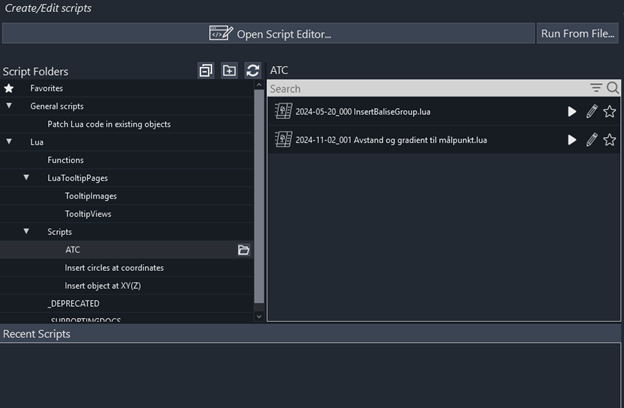
The run script button has been replaced by a run script menu. This provides an overview of your scripts including easy access to all your script folders, the ability to pin favorite scripts and a list of recently run scripts.

Picture of script menu

Lua Debugger

The debugger is improved with a new environment tab to see predefined global variables. We have cleaned up the keyboard shortcuts. “Add Watch” is now Ctrl+T instead of the former Ctrl+W (which is “Close Window” in most contexts).

Text Attributes

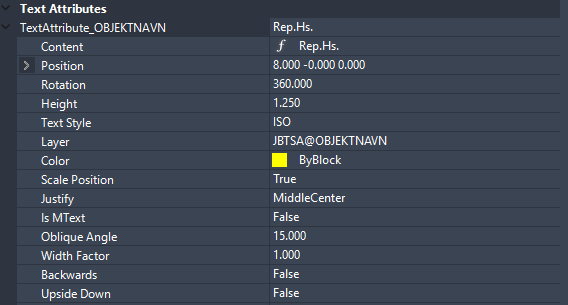
Text Attributes can now be edited in the Property manager. The text can be set directly from the Content sub-property, as a direct value or as a formula. As before, text attributes can only be declared in DNA – the user can neither add nor remove text attributes.

Screenshot of text attribute section of property manager

Value and Formula Picker

When editing several objects at once, you can now use “Pick Value” (F6) or “Pick Formula” (F7) to select the same value or formula for all the objects. You can also use this tool to make a new selection set consisting of all objects having the same value or formula as the one you select from the menu of available values / formulas.

The Value / Formula picker largely makes the existing command RC-EditProperties obsolete.

Screenshot of pick formula button in property manager
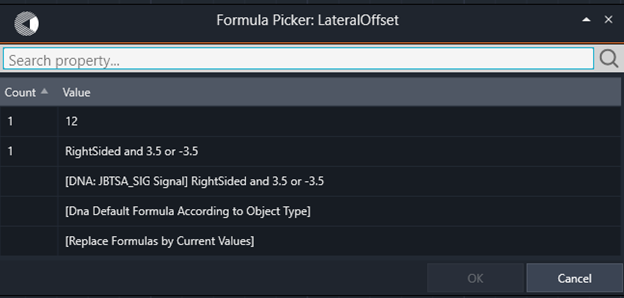
Screenshot of Pick Formula Window

Excel exports of tables are now much faster.

In addition to this there are lots of minor UI improvements, small features, and bugfixes.

RC 2024.2 – bedre 3D-tekstkommentarer enn noensinne

3D Text Annotation

Med RC 2024.2 er det blitt lynraskt å få 3D-grafikk til å vises med annoteringer. 3D-glyfer (bokstaver, sifre, tegnsetting osv.) hentes nå fra et forhåndsdefinert sett når du har behov for å annotere objektene dine. Med den nye kommandoen RC-Create3DTextStyle kan du konvertere en hvilken som helst tekststil (font) på datamaskinen din til en 3D-tekststil som RC kan bruke til 3D-annoteringer. Kommandoen for oppretting av 3D-tekststil beregner også kerning for alle kombinasjoner av to bokstaver.

Andre høydepunkter for 2024.2:

  • Redusert størrelse for eksporterte 3D-filer (DWG eller IFC)
  • Bedre kontrast i menyene i Pset Definitions Manager
  • Bedre verktøytips i Pset Definitions Manager
  • Bedre sorteringsalternativer i Pset Definitions Manager
  • Flytting av hovedobjektets visningspunkt vil nå også flytte alle tilknyttede objekters visningspunkter tilsvarende.
  • Feilrettinger

RC 2024.2 – Des annotations de texte en 3D plus efficaces que jamais

3D Text Annotation

Avec la RC 2024.2, faire apparaître des graphiques 3D avec des annotations est devenu rapide comme l’éclair. Les glyphes 3D (lettres, chiffres, ponctuation, etc.) sont désormais extraits d’un ensemble prédéfini chaque fois que vous avez besoin d’annoter vos objets. La nouvelle commande RC-CreerStyleDeTexte3D permet de convertir n’importe quel style de texte (police) de votre ordinateur en un style de texte 3D que RC peut utiliser pour les annotations 3D. La commande de création de style de texte 3D calcule également le crénage de toutes les combinaisons de deux lettres.

Autres nouveautés de la version 2024.2:

  • Réduction de la taille des fichiers 3D exportés (DWG ou IFC)
  • Meilleur contraste dans les menus du gestionnaire de définitions de jeux de caractères
  • Meilleures infobulles dans le gestionnaire de définitions Pset
  • Meilleures options de tri dans le gestionnaire de définitions Pset
  • Le déplacement du point d’affichage de l’objet principal entraîne désormais le déplacement des points d’affichage de tous les objets attachés.
  • Corrections de bogues

RC 2024.2 – Bessere 3D-Textanmerkungen als je zuvor

3D Text Annotation

Mit RC 2024.2 lassen sich 3D-Grafiken blitzschnell mit Anmerkungen versehen. 3D-Glyphen (Buchstaben, Ziffern, Satzzeichen usw.) werden jetzt aus einem vordefinierten Satz geholt, wenn Sie Ihre Objekte beschriften wollen. Mit dem neuen Befehl RC-Erstellen3DTextStil können Sie jeden Textstil (Schriftart) auf Ihrem Computer in einen 3D-Textstil umwandeln, den RC für 3D-Anmerkungen verwenden kann. Der Befehl zur Erstellung von 3D-Textstilen berechnet auch das kerning aller Zweibuchstabenkombinationen.

Weitere Highlights für 2024.2:

  • Geringere Größe für exportierte 3D-Dateien (DWG oder IFC)
  • Besserer Kontrast in den Menüs des Setdefinitions-Managers
  • Bessere Tooltips im Setdefinitions-Manager
  • Bessere Sortieroptionen im Setdefinitions-Manager
  • Wenn Sie den Anzeigepunkt des Hauptobjekts verschieben, werden nun auch die Anzeigepunkte aller angehängten Objekte entsprechend verschoben.
  • Fehlerbehebungen

RC 2024.2 – Better 3D Text Annotations Than Ever

3D Text Annotation

With RC 2024.2, making 3D graphics appear with annotations has become lightning fast. 3D glyphs (letters, digits, punctuation etc) are now fetched from a predefined set whenever you need to annotate your objects. With the new command RC-Create3DTextStyle you can convert any text style (font) on your computer into a 3D text style that RC may use for 3D annotations. The 3D text style creation command also computes the kerning for all two-letter combinations.

Other highlights for 2024.2:

  • Reduced size for 3D exported files (DWG or IFC)
  • Better contrast in Pset Definitions Manager menus
  • Better tooltips in the Pset Definitions Manager
  • Better sorting options in the Pset Definitions Manager
  • Moving the main object’s display point will now move also all attached objects’ display points accordingly.
  • Bug fixes


Would you like to receive our newsletter?